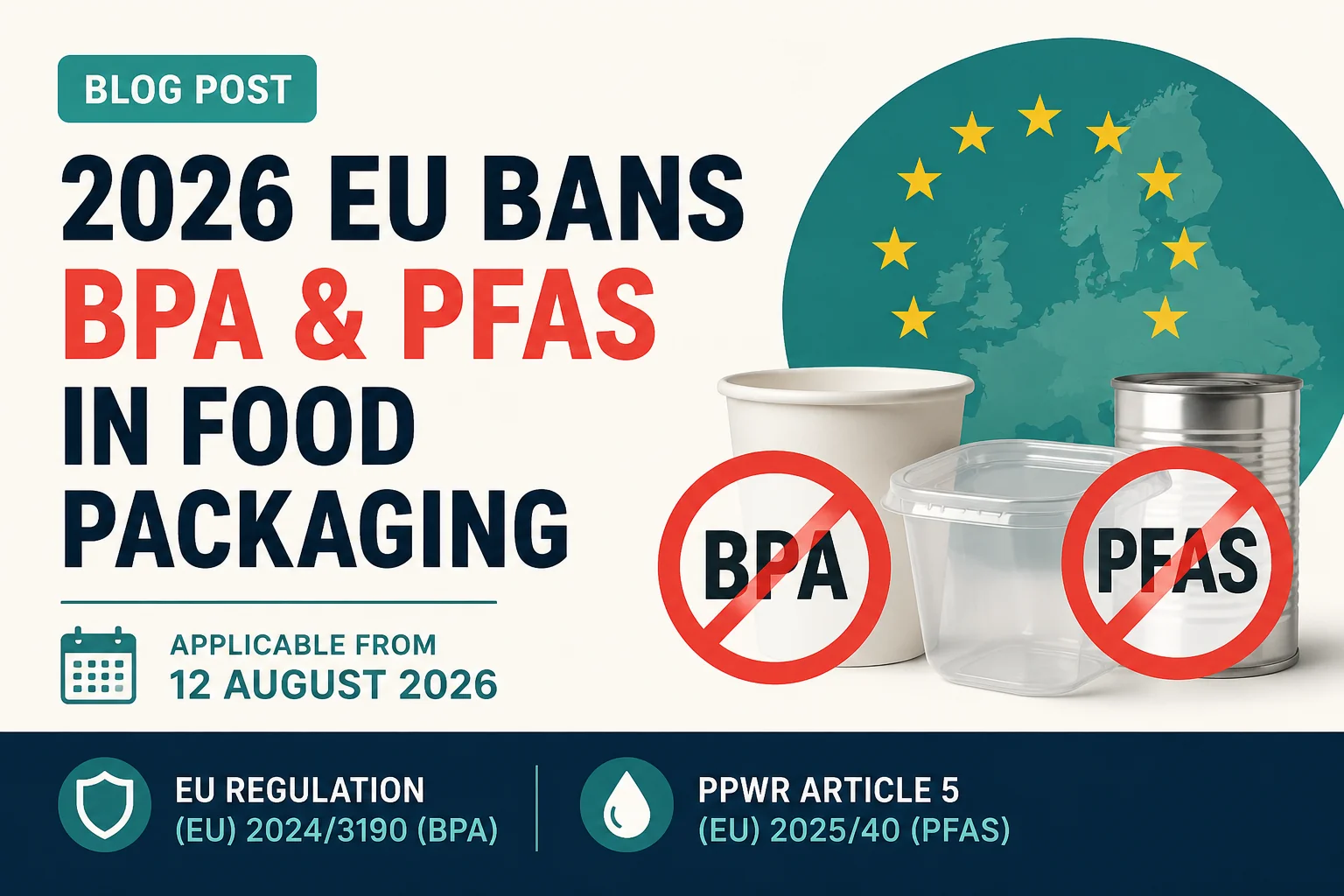
Het voedsel in je boodschappentas krijgt de meeste aandacht. De verpakking eromheen meestal niet. Dat staat op het punt te veranderen. Twee grote EU-verboden op chemische stoffen in materialen die met voedsel in contact komen, treden deze zomer volledig in werking — BPA in blik en flessen, en PFAS in vetwerend papier en karton. Beide laten al lang op zich wachten, beide zullen de Europese schappen stilletjes hervormen, en geen van beide staat op het soort etiket dat je met een scanner-app kunt lezen.
Dit is wat er werkelijk wordt verboden, waarom, en wat het betekent voor wat je uit de supermarkt meeneemt.
Wat wordt er in 2026 verboden?
Twee aparte stukken EU-regelgeving, die ongeveer in hetzelfde tijdvenster vallen:
- BPA (bisfenol A) wordt verboden in materialen die met voedsel in contact komen onder de Verordening (EU) 2024/3190 van de Commissie, die in januari 2025 in werking trad en tot en met 2026 volledig van kracht wordt.
- PFAS (per- en polyfluoralkylstoffen) — de 'eeuwige chemicaliën' — worden verboden in verpakkingen die met voedsel in contact komen onder de Verordening verpakkingen en verpakkingsafval (PPWR), Verordening (EU) 2025/40, waarbij de PFAS-specifieke bepalingen van toepassing zijn vanaf 12 augustus 2026.
Beide verboden gelden voor verpakkingen die vanaf die data op de EU-markt worden gebracht. Er is geen overgangsregeling voor de PFAS-regel, wat betekent dat zelfs verpakkingen die vóór augustus 2026 zijn gemaakt, na die datum niet meer in de EU mogen worden verkocht als ze de grenswaarden overschrijden.
Wat is BPA, en waarom wordt het verboden?
BPA is een chemische stof die sinds de jaren 1950 wordt gebruikt om polycarbonaatkunststoffen en epoxyharscoatings te maken. In voedselverpakkingen wordt het vooral geassocieerd met de binnenbekleding van metalen blikken (waar het voorkomt dat het blik corrodeert), met epoxygecoate tankbekledingen in de voedselproductie, en met hervulbare polycarbonaatflessen.
De zorg is dat BPA een hormoonverstorende stof is — een stof die de hormoonsignalering verstoort, zelfs bij zeer lage doses. De EFSA verlaagde haar toelaatbare dagelijkse inname voor BPA in 2023 drastisch (met een factor van ongeveer 20.000 ten opzichte van het vorige niveau), wat het groeiende bewijs over effecten op het immuunsysteem, de voortplantingsgezondheid en de stofwisselingsfunctie weerspiegelt. Het antwoord van de Commissie, Verordening 2024/3190, verbiedt het gebruik van BPA en diverse nauw verwante bisfenolen in materialen die bedoeld zijn om met voedsel in contact te komen.
De meest getroffen categorieën:
- Voedsel en drank in blik — soep, groenten, vis, bonen, diervoeding, bierblikjes.
- Hervulbare polycarbonaat-waterflessen, waaronder het soort dat in waterkoelers op kantoor wordt gebruikt.
- Coatings op tankbekledingen voor voedselverwerking.
- Herbruikbaar plastic serviesgoed en bestek dat BPA bevatte.
Vervangende materialen worden al breed gebruikt — BPA-NI-coatings (BPA non-intent), bekledingen op polyesterbasis, en alternatieve bisfenolen zoals BPF en BPC. Of die vervangers wezenlijk veiliger zijn, is zelf een onderzoeksvraag; sommige eerste studies suggereren dat de alternatieven hun eigen hormoonverstorende effecten hebben, wat deels verklaart waarom Verordening 2024/3190 ook diverse aan BPA verwante stoffen beperkt, niet alleen BPA zelf.
Wat zijn PFAS, en waarom worden ze verboden?
PFAS zijn een familie van ongeveer 10.000 synthetische chemische stoffen die bekendstaan om hun extreme effectiviteit in het afstoten van water en vet, en om hun extreme persistentie in het milieu — vandaar de bijnaam 'eeuwige chemicaliën'. Ze worden sinds de jaren 1950 in voedselverpakkingen gebruikt, overal waar papier of karton bestand moet zijn tegen olie, vet of vocht.
Bij voedselcontact duiken PFAS het vaakst op in:
- Pizzabezorgdozen (vetbestendigheid)
- Magnetronpopcornzakken
- Fastfoodverpakkingen en hamburgerbakjes
- Koffiebekers om mee te nemen en wegwerpkommen (waterdichtheid)
- Bakkerij- en banketpapier dat vetdicht moet zijn
- Sommige plantaardige gevormde verpakkingen die zich als composteerbaar verkopen
De gezondheidszorg is dat PFAS bioaccumuleren. Ze breken niet noemenswaardig af in het menselijk lichaam of in het milieu, en blootstelling is in observationele studies in verband gebracht met hormoonverstoring, immuundisfunctie, leverproblemen en bepaalde kankers. PFAS zijn aangetroffen in het bloed van vrijwel elke Europeaan die erop is getest — waaronder, bij een recente symbolische test, meerdere EU-commissarissen en ministers — en in moedermelk.
De PPWR stelt concrete grenswaarden: 25 ppb voor elke afzonderlijke beoogde PFAS, 250 ppb voor de som van de beoogde PFAS, en 50 ppm voor de totale PFAS, inclusief polymere. Boven een van die drempels mag de verpakking vanaf 12 augustus 2026 niet op de EU-markt worden gebracht.
In maart 2026 ging het Europees Agentschap voor chemische stoffen (ECHA) verder en steunde het formeel een veel bredere EU-brede beperking van PFAS in de meeste toepassingen. Naar verwachting beslist de Commissie vóór eind 2026 of zij daarop ingaat. Zweden, Denemarken, Duitsland, Noorwegen en Nederland waren de belangrijkste aanjagers van dat bredere verbod.
Waarom gebeurt dit nu?
Een aantal dingen kwam samen. De wetenschap over zowel BPA als PFAS wordt al een decennium gestaag sterker, maar versnelde scherp begin jaren 2020 — met name de BPA-herbeoordeling van de EFSA in 2023 en het groeiende PFAS-dossier van de ECHA. Nationaal optreden liep vooruit op EU-optreden: Frankrijk nam in februari 2025 zijn eigen aanvullende PFAS-wet aan, Nederland was actief in het bepleiten van het EU-brede verbod, en Denemarken voerde nationale PFAS-verboden in textiel in. De Commissie kwam deels in actie om regelgevende versnippering tussen lidstaten te voorkomen.
Er is ook een echte factor van consumentendruk. PFAS-tests van afhaalverpakkingen door Europese ngo's in de afgelopen drie jaar leverden een reeks mediaverhalen op over de verontreiniging van specifieke merken en productcategorieën. Zodra het onderwerp op het netvlies van de consument stond, kwam de politiek in beweging.
Wat betekent dit voor de producten in het schap?
Een paar praktische effecten die je in de tweede helft van 2026 en in 2027 kunt verwachten:
- Producten in blik met BPA-houdende bekledingen worden uitgefaseerd, vervangen door BPA-NI- of polyesterbasis-alternatieven. Sommige fabrikanten doen dit al jaren; de verordening dicht het gat.
- Pizzadozen, popcornzakken, fastfoodverpakkingen en afhaalbakjes worden geherformuleerd. Verwacht meer siliconengecoat of speciaal behandeld papier, meer wasgecoate alternatieven, en meer composteerbare gevormde vezel — al verdient de claim 'composteerbaar' zelf vaak controle.
- Sommige producten kunnen kort duurder worden terwijl fabrikanten de herformuleringskosten opvangen, vooral in de blikcategorieën met lage marges.
- Import is niet vrijgesteld. Geïmporteerde voedselverpakkingen die na de deadlines de EU binnenkomen, moeten dezelfde grenswaarden halen.
De verboden behandelen niet elke zorg rond voedselcontact. Ftalaten, minerale-oliekoolwaterstoffen en diverse andere weekmakers blijven punten van doorlopend toezicht in plaats van een verbod. En gerecyclede materialen — steeds vaker verplicht onder andere delen van de PPWR — kunnen zelf PFAS of BPA bevatten uit hun oorspronkelijke gebruik, wat een bekende nalevingsuitdaging is voor de sector.
Waar een voedselscanner-app kan helpen (en waar niet)
Eerlijke kadering: een scanner-app leest de ingrediëntenlijst en de voedingswaardetabel van een product. Verpakkingschemie staat op geen van beide. Een tool zoals Nime vertelt je dus niet of een specifiek blik een BPA-NI-coating heeft of dat een bepaalde pizzadoos PFAS-vrij is. Die informatie zit in de nalevingsdocumentatie van de fabrikant, niet op het consumentenetiket.
Waar een scanner wel bij helpt — en waar de connectie met verpakking ertoe doet:
- De afhankelijkheid van zwaar verpakte ultrabewerkte voeding verminderen. De categorieën die in de verpakking het meest aan PFAS zijn blootgesteld (afhaal, magnetrongeschikt, vetwerend) overlappen sterk met de categorieën die ook hoog zijn in additieven, natrium en ultrabewerkte ingrediënten. Daar minder van eten — om welke reden dan ook — verlaagt doorgaans de PFAS-blootstelling als neveneffect.
- Verstandig blikalternatieven kiezen. Sommige voedingsmiddelen in blik (bonen, tomaten, vis op water) zijn voedingskundig een gezonde keuze, en na 2026 daalt hun BPA-risico aanzienlijk terwijl de verordening de voorraad doorwerkt. Een scanner helpt je opties te vergelijken op de werkelijke voedingswaarde.
- 'Natuurlijke' of 'composteerbare' verpakkingsclaims spotten die verificatie nodig hebben. De verordening dwingt fabrikanten die PFAS-vrij claimen om dat met documentatie te onderbouwen, en tests van consumentenwaakhonden zullen waarschijnlijk volgen. Een scanner-app helpt je de reputatie van een merk over zijn producten heen bij te houden.
Een redelijke vuistregel: de verordening doet het zware werk over wat verboden is. De scanner doet het zware werk over wat er in je mandje zit.
Veelgestelde vragen
Zijn BPA-houdende blikken op dit moment nog legaal in de EU?
De overgang is gaande. Verordening (EU) 2024/3190 trad op 20 januari 2025 in werking, waarbij het belangrijkste verhandelingsverbod voor BPA in materialen die met voedsel in contact komen van kracht wordt na een overgangsperiode die tot en met 2026 loopt. Bestaande voorraad met BPA-houdende coatings wordt in deze periode uitverkocht. Vanaf medio 2026 zijn fabrikanten die nieuwe BPA-houdende verpakkingen op de EU-markt brengen in overtreding.
Wanneer treedt het PFAS-verbod voor voedselverpakkingen precies in werking?
De PFAS-bepalingen van de Verordening verpakkingen en verpakkingsafval (Verordening (EU) 2025/40) zijn van toepassing vanaf 12 augustus 2026 in de hele EU. Na die datum mogen verpakkingen die met voedsel in contact komen en PFAS bevatten boven de gespecificeerde drempels — 25 ppb individueel, 250 ppb som van de beoogde PFAS, 50 ppm totaal — niet op de EU-markt worden gebracht, ongeacht wanneer ze zijn gemaakt.
Kan ik aan een verpakking zien of die BPA of PFAS bevat?
Doorgaans niet rechtstreeks. Het verbod verplicht fabrikanten de naleving te waarborgen, maar de verordening schrijft geen 'BPA-vrij'- of 'PFAS-vrij'-etiket op de voorkant voor. Sommige fabrikanten kiezen ervoor het als marketingpunt te vermelden — en tests van consumentenwaakhonden in lidstaten zullen daar waarschijnlijk op volgen. Vanaf medio 2026 is de veiligere aanname dat reguliere EU-verpakkingen aan de nieuwe grenswaarden voldoen, waarbij ngo-tests eventuele uitschieters markeren.
Zijn de vervangende materialen veiliger?
Waarschijnlijk, maar niet zeker. BPA-vervangers zoals BPF, BPC en andere bisfenolen zijn minder onderzocht dan BPA zelf, en sommig vroeg onderzoek suggereert dat ze vergelijkbare hormoonverstorende effecten hebben — wat deels verklaart waarom de EU-verordening een groep bisfenolen bestrijkt, niet alleen BPA op zich. PFAS-vervangers lopen sterk uiteen; alternatieven van silicone, was en gevormde vezel worden over het algemeen als beter beschouwd. Consumentengroepen zullen de vervangers blijven onderzoeken, en verdere beperkingen zijn waarschijnlijk.
Geldt dit voor import?
Ja. Beide verordeningen gelden voor alle verpakkingen die op de EU-markt worden gebracht, ongeacht waar ze zijn gemaakt. Geïmporteerd voedsel in BPA-gecoate blikken of met PFAS behandelde verpakkingen mag na de betreffende deadlines niet in de EU worden verkocht.
Bronnen: Verordening (EU) 2024/3190 van de Commissie over het gebruik van BPA en bisfenolen in materialen die met voedsel in contact komen; Verordening (EU) 2025/40 (Verordening verpakkingen en verpakkingsafval), artikel 5; advies van het Comité risicobeoordeling van de ECHA over de PFAS-beperking, maart 2026; wetenschappelijk advies van de EFSA over BPA, april 2023; rapporten van het Europees Milieuagentschap over PFAS in Europese wateren; Euronews, maart 2026.