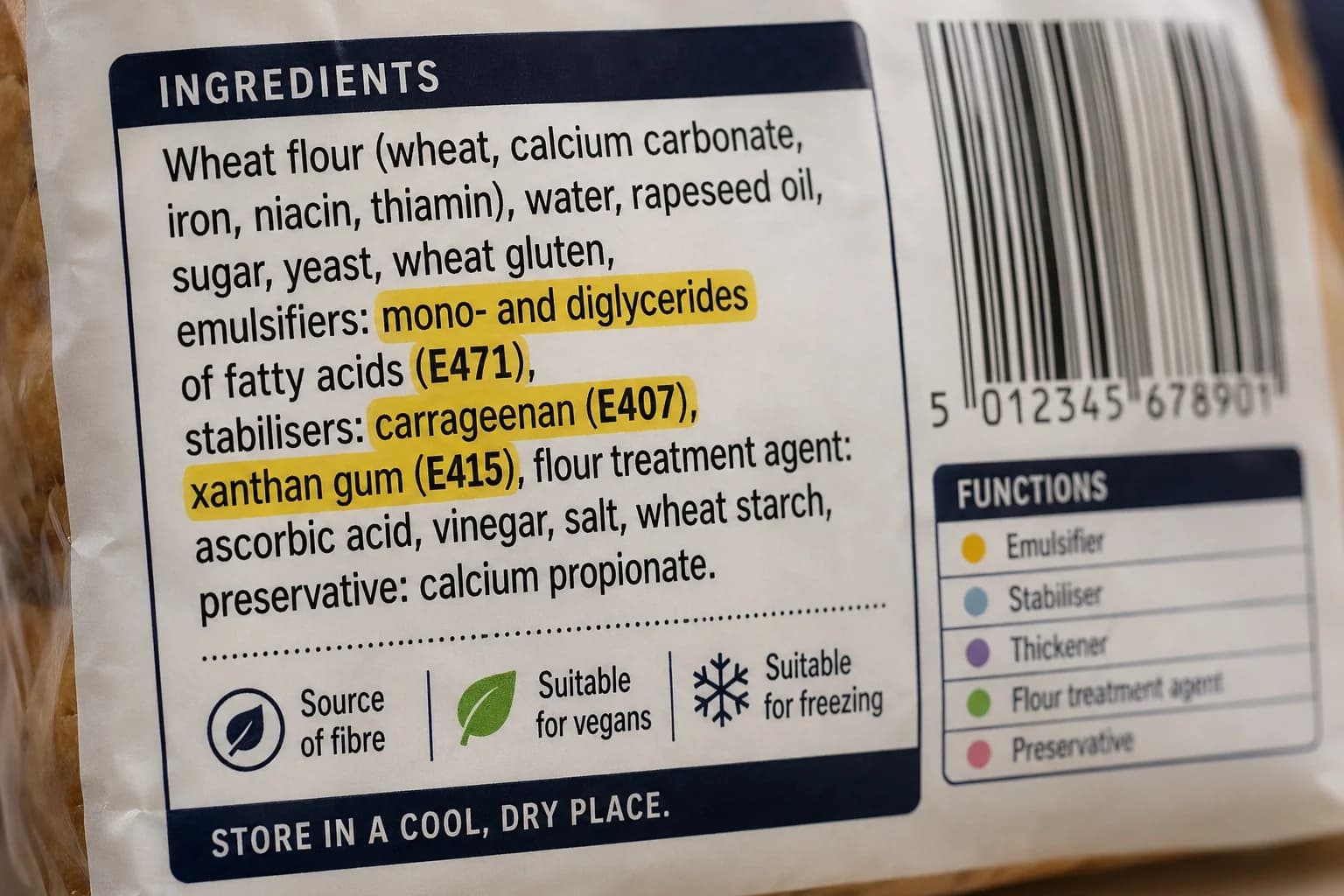
Emulgatoren zijn het soort ingrediënt waar de meeste mensen nooit over hebben nagedacht — en dat ze, zodra ze etiketten gaan lezen, vervolgens absoluut overal terugvinden. Ze zitten in supermarktbrood, ijs, haverdrank, hummus, pindakaas, kaasplakken, plantaardige 'kip', zelfs in sommige yoghurts die zichzelf als gezond verkopen. Ze smaken nergens naar. Ze komen niet voor in de marketing. En de afgelopen jaren zijn ze een van de meest onderzochte hoeken van de voedselwetenschap geworden, met een aantal werkelijk interessante — en zorgwekkende — bevindingen uit grote Europese studies.
Dus: wat zijn ze, wat weten we er werkelijk over, en is het de moeite waard om te letten op welke er in je mandje liggen? Hier is de eerlijke versie.
Wat is een emulgator?
Een emulgator is een voedseladditief dat helpt om twee dingen die normaal niet zouden mengen toch te mengen — meestal olie en water. Dat is zijn hele taak. Zonder emulgator drijft de olie in een slasaus naar boven, wordt ijs korrelig en schift chocolade. Met een emulgator blijft alles glad, romig en maandenlang stabiel in het schap.
Er zijn tientallen goedgekeurde emulgatoren in de EU. Sommige klinken vrij natuurlijk — lecithine uit soja of zonnebloem (E322), pectine uit appels (E440). Andere zijn industriëler: mono- en diglyceriden van vetzuren (E471), carrageen (E407), polysorbaat 80 (E433), carboxymethylcellulose (E466), xanthaangom (E415). Ze staan allemaal op etiketten, met naam of met E-nummer — en de meeste producten gebruiken er meerdere tegelijk.
Hier een getal om even bij stil te staan: in een recente studie onder Franse volwassenen waren zeven van de tien meest geconsumeerde voedseladditieven emulgatoren. Niet omdat iemand zijn best doet om ze te eten, maar omdat ze ingebouwd zitten in zo veel van wat er in het schap ligt.
Zijn emulgatoren veilig?
Hier wordt het interessant, en hier moet je oppassen de zaak niet in de ene of de andere richting te overdrijven.
Het officiële standpunt is duidelijk: elke emulgator op de EU-markt is beoordeeld door de EFSA, de Europese Autoriteit voor voedselveiligheid, en goedgekeurd binnen specifieke maximale gebruiksniveaus. Volgens de maatstaven van de toezichthouder zijn ze veilig. Het Voedingscentrum en vergelijkbare instanties in andere EU-landen bevestigen dit — er is geen goed bewijs dat een afzonderlijke emulgator in normale hoeveelheden je schaadt.
Maar het beeld dat de afgelopen jaren uit het onafhankelijke onderzoek naar voren komt, is ingewikkelder, en het is goed om dat te weten.
Wat het darmmicrobioomonderzoek heeft gevonden
Vanaf ongeveer 2015 begonnen lab- en dierstudies te suggereren dat sommige emulgatoren — zelfs in hoeveelheden die vergelijkbaar zijn met wat mensen werkelijk eten — het darmmicrobioom kunnen verstoren. Het mechanisme is, grofweg, dat bepaalde emulgatoren de beschermende slijmlaag van de darm dunner maken, waardoor bacteriën dichter bij de darmwand komen dan ze normaal zouden doen. Dat kan een laaggradige ontsteking uitlokken. De meest bestudeerde stoffen hier zijn carboxymethylcellulose (E466) en polysorbaat 80 (E433).
Een overzichtsstudie uit 2025 van de bredere literatuur concludeerde dat ultrabewerkte voeding — door hun opzet emulgatorrijk — geassocieerd is met verminderde microbiële diversiteit, lagere niveaus van nuttige bacteriën zoals Akkermansia muciniphila en Faecalibacterium prausnitzii, en een toename van pro-inflammatoire soorten. Recent in-vitro-werk heeft aangetoond dat zelfs 'natuurlijke' emulgatoren de samenstelling van de darmmicrobiota kunnen verschuiven, waarbij het effect de emulgerende sterkte volgt in plaats van de vraag of de bron chemisch of biologisch is.
Dit is dier- en labwerk. Het bewijst niet dat hetzelfde op betekenisvolle schaal gebeurt bij mensen met een gewoon voedingspatroon. Maar het is consistent genoeg geweest over laboratoria heen dat toezichthouders er aandacht aan besteden.
Wat het onderzoek bij mensen heeft gevonden
Het meest aangehaalde bewijs bij mensen komt uit het Franse NutriNet-Santé-cohort, een langlopende studie onder meer dan 100.000 Franse volwassenen. Drie artikelen van die groep, tussen 2023 en 2024, keken naar emulgatorinname tegenover drie verschillende gezondheidsuitkomsten:
- Hart- en vaatziekten (BMJ, 2023): een hogere inname van bepaalde emulgatoren — waaronder cellulosen (E460, E466) en mono- en diglyceriden van vetzuren (E471, E472) — was geassocieerd met een hoger risico op hart- en vaatziekten.
- Kanker (PLOS Medicine, 2024): een hogere inname van E471, totale carrageenen (E407, E407a) en xanthaangom (E415) was geassocieerd met een hoger algeheel kankerrisico, met specifieke signalen voor borst- en prostaatkanker.
- Diabetes type 2 (Lancet Diabetes & Endocrinology, 2024): meerdere emulgatoren, waaronder E407, E412 (guargom) en E472e, werden in verband gebracht met een hoger risico op diabetes type 2.
Dit zijn observationele bevindingen, geen bewijs van oorzaak. De auteurs zeggen dat zorgvuldig. Maar ze zijn groot, consistent van richting, en het zijn de eerste datapunten op menselijke schaal in een verhaal dat tot dan toe alleen bij muizen en in petrischalen had bestaan.
Het 'cocktaileffect' waar niemand op heeft getest
Hier komt het deel dat onderzoekers het meest dwarszit. Elk additief op de EU-lijst van 338 goedgekeurde stoffen is afzonderlijk getest. Maar je eet niet één additief tegelijk — een typische kant-en-klaarmaaltijd kan tien verschillende E-nummers bevatten, een verpakt dessert haalt er gemakkelijk vijftien. Hoe die stoffen met elkaar interageren, en met wat er verder op een bepaalde dag in je darm zit, is in feite nooit op bevolkingsschaal onderzocht.
Dit is wat consumentengroepen zoals foodwatch het cocktaileffect noemen. De bijgewerkte EFSA-richtsnoeren van 2026 voor nieuwe aanvragen voor voedseladditieven, die vanaf 20 juli 2026 bindend worden voor nieuwe indieningen, vereisen voor het eerst formeel dat aanvragers rekening houden met mengeffecten. Dat is een betekenisvolle regelgevende verschuiving. Het betekent ook dat de stoffen die al op de markt zijn — die in je wekelijkse boodschappen — nooit op die manier zijn beoordeeld.
Waar je emulgatoren in je wekelijkse boodschappen vindt
Als je nooit aandacht hebt besteed aan dit deel van het etiket, is de inventaris werkelijk verrassend. Veelvoorkomende plekken waar emulgatoren opduiken:
- Brood — vooral lang houdbaar supermarktbrood, waar E471 vrijwel standaard is.
- IJs — mono- en diglyceriden, carrageen, guargom, johannesbroodpitmeel, vaak drie of vier samen.
- Plantaardige melk — veel haver-, amandel- en sojadranken gebruiken gellaangom, carrageen of lecithine om te voorkomen dat ze schiften.
- Smeersels, pindakaas, hummus, dips — emulgatoren stabiliseren de textuur.
- Kaasplakken, smeltkaas, 'kaasachtige' producten — vrijwel altijd.
- Sauzen, sauzen van kant-en-klaarmaaltijden, instantsoepen — emulgatoren en verdikkingsmiddelen doen het meeste textuurwerk.
- Plantaardige vleesvervangers — methylcellulose (E461) komt veel voor, naast diverse andere.
- Supermarktyoghurt en kwark met toegevoegde smaken — bevatten vaak pectine, gemodificeerde zetmelen of carrageen.
Het patroon: hoe meer bewerkt en hoe langer houdbaar, hoe meer emulgatoren je zult zien.
Hoe je het daadwerkelijk controleert
Je hoeft geen lijst met E-nummers uit je hoofd te leren. De snelste manier is de barcode scannen. Een voedselscanner zoals Nime leest de volledige ingrediëntenlijst in een paar seconden, markeert emulgatoren (en andere additiefcategorieën — zoetstoffen, kleurstoffen, conserveermiddelen), en laat je zien hoe een product zich verhoudt tot alternatieven in dezelfde categorie. Dat laatste telt zwaarder dan mensen verwachten: twee haverdranken naast elkaar in hetzelfde schap kunnen heel verschillende additiefprofielen hebben.
Een paar praktische vuistregels die ook zonder app werken:
- Brood van een bakker heeft meestal minder emulgatoren dan lang houdbaar supermarktbrood. De ingrediëntenlijst van een echt brood telt vaak vier items.
- Naturel volle yoghurt bevat vrijwel nooit emulgatoren. De gearomatiseerde varianten vaak wel.
- Een korte ingrediëntenlijst is, grofweg, een goed teken — geen garantie, maar wel een goed signaal.
- 'Plantaardig' betekent niet automatisch minder additieven; sommige categorieën plantaardige alternatieven behoren tot de meest additiefrijke producten in de supermarkt.
Het punt is niet om in angst voor elk E-nummer te leven. Het is dat sommige van deze stoffen in het onderzoek opduiken met patronen die aandacht verdienen, dat het regelgevende kader mengeffecten serieuzer begint te nemen, en dat de enige manier om een persoonlijke keuze te maken is te weten wat je werkelijk eet.
Veelgestelde vragen
Wat is het verschil tussen een emulgator en een stabilisator?
De taak is vergelijkbaar maar niet identiek. Een emulgator helpt olie en water te mengen; een stabilisator voorkomt dat een mengsel na verloop van tijd schift. Veel additieven doen beide — carrageen, xanthaangom en pectine staan in sommige producten als stabilisator vermeld en in andere als emulgator. Op een etiket wordt de functie ('emulgator', 'stabilisator', 'verdikkingsmiddel') vóór de naam of het E-nummer getoond.
Zijn natuurlijke emulgatoren veiliger dan synthetische?
Niet automatisch. Lecithine uit soja of zonnebloem heeft een lange staat van dienst van veilig gebruik en wordt breed beschouwd als een van de minder zorgwekkende emulgatoren. Maar recent in-vitro-werk heeft aangetoond dat zelfs biotechnologisch geproduceerde 'natuurlijke' emulgatoren de darmmicrobiota op vergelijkbare manieren kunnen verschuiven als synthetische — en in sommige gevallen meer. Het effect lijkt de emulgerende sterkte te volgen, niet de natuurlijke versus synthetische oorsprong.
Welke emulgatoren worden in het onderzoek het meest met gezondheidszorgen geassocieerd?
In dier- en in-vitro-studies: carboxymethylcellulose (E466) en polysorbaat 80 (E433) zijn de meest aangehaalde. In het Franse menselijke NutriNet-Santé-cohort: mono- en diglyceriden van vetzuren (E471), carrageenen (E407, E407a) en xanthaangom (E415) toonden associaties met kanker; cellulosen (E460, E466) en E471/E472 met hart- en vaatziekten; en guargom (E412) en diverse andere met diabetes type 2. Dit zijn associaties, geen bewezen oorzaken.
Moet ik emulgatoren helemaal vermijden?
Waarschijnlijk niet realistisch, en niet wat de meeste onderzoekers op dit gebied voorstellen. De nuttigere insteek is de totale inname van ultrabewerkte voeding te verlagen — wat de blootstelling aan emulgatoren automatisch verlaagt — en aandacht te besteden aan de categorieën waar de emulgatorbelasting hoog is (lang houdbaar brood, ijs, plantaardige vleesvervangers, gearomatiseerde zuivel). Voor specifieke producten die je regelmatig eet, is scannen om alternatieven te vergelijken een snelle manier om de additiefarmere keuze te maken zonder je boodschappen om te gooien.
Waar kan ik zien hoeveel emulgatoren in een product zitten?
De volledige lijst staat op de achterkant van de verpakking, in de ingrediëntenlijst. Emulgatoren worden geëtiketteerd met hun functie ('emulgator', 'stabilisator', 'verdikkingsmiddel'), gevolgd door de naam of het E-nummer. Een scanner-app zoals Nime splitst dit automatisch uit en markeert additiefcategorieën, zodat je niet elk E-nummer op het zicht hoeft te herkennen.
Bronnen: Frans NutriNet-Santé-cohort — BMJ, september 2023 (hart- en vaatziekten); PLOS Medicine, februari 2024 (kanker); Lancet Diabetes & Endocrinology, 2024 (diabetes type 2). Rondinella et al., Nutrients, februari 2025 (overzicht ultrabewerkte voeding en darmmicrobioom). EFSA wetenschappelijke richtsnoeren voor voedseladditieven, gepubliceerd op 20 januari 2026, van toepassing op nieuwe aanvragen vanaf 20 juli 2026. Open Food Facts; foodwatch.